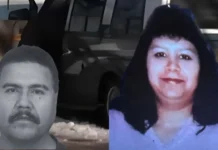
For 33 years, investigators working the Randy Gail Sperino cold case had evidence. They had a truck description, and they even had DNA, but they did not have a name. Madison County, Illinois, investigators say forensic genetic genealogy has now led to an arrest in her 1993 killing.
Sheriff Jeff Connor said deputies responded around 11:45 that night to an area off Horseshoe Lake Road on Hanfelder Lane, outside Granite City. There, deputies found a woman’s body on the side of the road in a field. Officials said someone had dragged her across the ground and left her there after bludgeoning her to death. Then a witness said Sprino got into a truck at 8:00 p.m. The property owners said they left at about 9:00 p.m. and she was not there. When they returned at 11:30 p.m., they found her. The crime happened sometime between 8:00 and 11:30, and someone left her body there sometime between 9:00 and 11:30.
For decades, investigators kept working the case. Sheriff Conner said they interviewed hundreds of people, and collected DNA samples because there was male DNA at the crime scene. In the early 2000s, Illinois State Police submitted that DNA profile to CODIS, but they did not get a hit. The Randy Gail Sperino cold case sat in that gap for years. CODIS was not nationally accessible until 1998, which explains why the DNA was not submitted earlier.
In May 2025, investigators gave the evidence to Othram Labs for advanced DNA testing. Othram scientists used forensic-grade genome sequencing to develop a SNP profile to use for forensic genetic genealogy. The explanation given was simple, CODIS can hold DNA from people required to give samples. Genealogy work can also connect through consumer ancestry databases and family matches. Those results do not name a guilty person. They give investigators leads, sometimes distant relatives, and a place to start. Sheriff Connor said the Madison County Sheriff’s Office investigative team received those leads. Detective Jake Svoboda took over the case. After investigators narrowed down the list, they identified 70-year-old Albert Lee Zigler as the suspect in Randy Gail Sperino’s case. Conner said Ziegler had nothing in his record that would have required a prison DNA sample for CODIS.
Investigators also said Ziegler was from the area, but there was no connection between him and Sprino. According to the sheriff, it appears he was driving down the street, she was walking, he picked her up, he took her, and he killed her. That detail makes the Randy Gail Sperino cold case even harder to process because Sprino no longer lived there. She was living in Charleston, Missouri, and was back home visiting her father right before Thanksgiving and the Christmas holiday season. The sheriff also said investigators confirmed that Ziegler had a vehicle registered to him that matched the truck description given by the witness who saw Sprino get in that night. The evidence is compelling, but the case still has to be proven in court.
They arrested Albert Lee Ziegler at his home on May 21, 2026. Madison County State’s Attorney Tom Haine charged Zigler with two counts of first-degree murder. One count alleges that Ziegler, with the intent to kill Randi Gail Sperino, beat her in the head with a bludgeon and caused her death. The second count is an alternative theory on the same death. The explanation given was that prosecutors are not alleging two separate murders. They are giving a jury more than one path to a first-degree murder conviction. Both counts still must be proven beyond a reasonable doubt.
At his detention hearing, public defender Mary Copeland argued for his release before trial. She cited his poor health, his age, and his lack of a violent criminal history.
More from CRIMEALTYICS®: 40 Year Old Remains Identified
She also argued that his physical condition made him unlikely to be a danger to the public. Assistant State’s Attorney Ryan Kemper pushed back and said the nature of the alleged crime showed a serious public safety concern. Judge John Hackett agreed with the state. He said the DNA evidence and Ziegler’s alleged confession to law enforcement were enough to presume he could have committed the crime and that no conditions could reduce the threat his release could pose.
That alleged confession is one part of the case that still appears unclear. Reports from the hearing said the judge mentioned a confession, but Detective Zavoda’s public remarks sounded more limited. He said investigators had lengthy discussions with Zigler. He believed Zigler had tried to suppress some of those memories for quite some time, and the way the interview ended surprised him. Because of that, it is more accurate at this point to let the court process show what was actually said. The Randy Gail Sperino cold case also reflects the work done in 1993. The original investigative team preserved the evidence and the crime scene well enough for today’s DNA testing to matter 33 years later.
Sprino’s family waited 33 years for an arrest, and her son, Wes Sprino, said he never thought this day would come. He thanked Madison County law enforcement and said he finally gets closure with his family, finally knows who did this, and can move through life into a different chapter.Zigler remains held in the Madison County Jail. Officials have not announced a trial date.. Hain also said that if Ziegler is convicted, the sentencing rules from 1993 would apply. Both first-degree murder counts carry a range of 20 to 60 years, but under the older rules he would serve 50 percent, roughly 20 to 30 years, with day-for-day credit. As with any criminal case, Albert Lee Ziegler is innocent until proven guilty in a court of law.
View Sources for This Report
Madison County Sheriff’s Office. “Randy Gail Sperino Cold Case News Conference.” YouTube.
View source
Othram / DNAsolves. “Madison County, Illinois Sheriff’s Office and Othram Team to Identify Suspect in the 1993 Homicide of Randy Gail Sperino.”
View source
RiverBender. “Madison County Judge Rejects Release Request For Zigler.”
View source
AOL / Belleville News-Democrat. “Man charged in Granite City murder case ordered held pending trial.”
View source
The Telegraph. “Caseyville man charged in 1993 murder cold case.”
View source
KSDK. “St. Louis-area murder cold case: Police arrest suspect in Granite City, Illinois.”
View source
Times Tribune News. “Caseyville man charged with murder of woman in Granite City in 1993.”
View source
Connect with CRIMEALYTICS®
For more CRIMEALYTICS® case analysis, updates, and missing-person coverage, subscribe on YouTube, listen on your favorite podcast app, follow @crimealtyics on social media, or submit a case suggestion.